

For many Malaysian SMEs, OKR implementation has become a key method to improve focus, alignment, and execution across teams. However, one important question often arises early in the journey: should you implement OKRs internally on your own, or work with a guided expert approach?
Both DIY and guided approaches can work, but they differ significantly in terms of speed, structure, risk, and long-term success. This guide breaks down both options in detail to help you decide what works best for your organization.
Why OKR Implementation Matters for SMEs
Before comparing approaches, it is important to understand why OKR implementation is so valuable for SMEs in the first place.
OKRs help organisations:
- Align teams with company priorities
- Improve clarity in goal setting
- Increase accountability and ownership
- Focus on high-impact outcomes
- Support scalable business growth
However, these benefits only appear when OKRs are implemented correctly and consistently.
The Real Problem Most SMEs Face With OKRs
Many SMEs assume OKRs are just a goal-setting template. In reality, OKR implementation is a behavioural and organisational change system.
Without proper structure, companies often face:
- Confusion between strategy and execution
- Goals that are too vague or too many
- Lack of ownership across teams
- Weak follow-through after setting OKRs
This is where the choice between DIY and guided implementation becomes critical.
Understanding DIY OKR Implementation
DIY OKR implementation means your organisation sets up and manages OKRs internally without external guidance or coaching.
This approach is typically chosen by SMEs that prefer full control over the process and want to develop their own understanding of OKRs through hands-on experience
Advantages of DIY OKR Implementation
- Lower upfront cost since no external consultants are involved
- Full control over how OKRs are designed and executed
- Flexibility to adjust the framework based on internal needs
- Helps build internal knowledge and familiarity with OKRs over time
Challenges of DIY OKR Implementation
- Lack of experience can lead to poorly structured OKRs
- Misunderstanding of objectives and key results is common
- Teams may struggle with alignment across departments
- Tracking progress can become inconsistent without proper systems
- Risk of low adoption if the framework is not clearly communicated
Without proper guidance, DIY OKR implementation can often feel like a trial-and-error process, especially in the early stages.
Understanding Guided OKR Implementation
Guided OKR implementation involves working with an experienced OKR coach in Malaysia or consultant who helps design, structure, and support the entire OKR process.
This approach is often used by SMEs that want a faster, more structured, and more reliable way to implement OKRs.
Advantages of Guided OKR Implementation
- Faster setup with a proven implementation framework
- Expert guidance reduces common OKR mistakes
- Stronger alignment across teams and departments
- Higher quality OKRs that are clear and measurable
- Better adoption and understanding across the organisation
Challenges of Guided OKR Implementation
- Higher upfront investment compared to DIY approach
- Requires active involvement from leadership
- Some dependency on external support during initial stages
Despite the cost, guided OKR implementation often delivers more consistent and sustainable results.
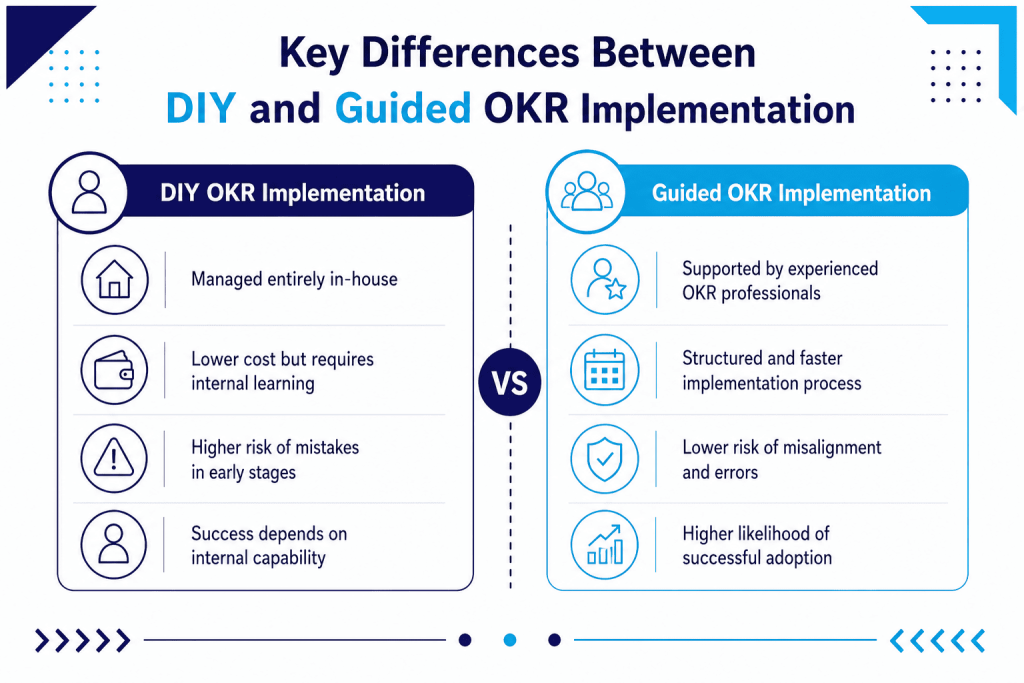
Key Differences Between DIY and Guided OKR Implementation
Both approaches aim to improve focus and alignment, but the experience and outcomes can be quite different.
DIY OKR Implementation
- Managed entirely in-house
- Lower cost but requires internal learning
- Higher risk of mistakes in early stages
- Success depends on internal capability
Guided OKR Implementation
- Supported by experienced OKR professionals
- Structured and faster implementation process
- Lower risk of misalignment and errors
- Higher likelihood of successful adoption
The right choice depends on your organisation’s experience level and readiness.
OKR Implementation Comparison Table
| Factor | DIY OKR Implementation | Guided OKR Implementation |
|---|---|---|
| Cost | Lower upfront cost | Higher initial investment |
| Speed | Slower learning curve | Faster structured rollout |
| Expertise | Internal knowledge only | External expert guidance |
| Risk Level | Higher risk of mistakes | Lower risk due to proven framework |
| Alignment | May be inconsistent | Strong and structured alignment |
| OKR Quality | Varies by experience | Consistently high quality |
| Adoption | Uneven across teams | Higher adoption rate |
| Scalability | Limited in early stages | Easier to scale across organisation |

Common OKR Implementation Mistakes SMEs Should Avoid
Even with the right approach, many SMEs struggle with OKR implementation due to avoidable mistakes that affect alignment and execution. These issues usually come from how OKRs are applied rather than the framework itself.
Setting Too Many Objectives
When too many objectives are set, focus gets diluted and priorities become unclear. Teams end up spreading effort too thin, which weakens overall results.
- Loss of focus on key priorities
- Slower execution across teams
- Reduced overall impact
Treating OKRs as Task Lists
OKRs are meant to measure outcomes, not daily activities. Treating them like task lists reduces their strategic value.
- Focus shifts from results to activities
- Weakens strategic alignment
- Turns OKRs into reporting tools
Ignoring Regular Check-Ins
Without consistent reviews, OKRs lose momentum quickly. Progress becomes unclear and issues are identified too late.
- Poor visibility on progress
- Delayed problem-solving
- Reduced accountability
Lack of Clear Ownership
Every OKR needs a clear owner to ensure progress is driven consistently. Without ownership, accountability becomes unclear.
- Confusion over responsibilities
- Weak follow-through
- Slower progress on key goals
When SMEs Typically See Results From OKR Implementation
Results from OKR implementation are not immediate, but most SMEs start seeing improvements within one to three cycles.
Early improvements usually come in the form of better alignment and clearer priorities. Over time, teams become more accountable and execution becomes more structured.
- Improved alignment in early cycles
- Clearer prioritisation of work
- Stronger accountability over time
- Results typically within 1–3 cycles
How to Improve OKR Implementation Success Rates
Most SMEs do not fail because of OKRs themselves, but because of execution gaps during OKR implementation. Small improvements in how OKRs are set and managed can significantly improve results.
Focus on keeping OKRs simple and easy to understand. Make sure they are outcome-based so progress can be measured clearly. Consistency in tracking is also important to keep teams aligned throughout the cycle.
- Keep OKRs simple and clear
- Focus on outcomes, not activities
- Maintain regular check-ins
- Track progress consistently
Ready to Improve Your OKR Implementation?
Struggling with alignment or unclear goals? Get expert help to make your OKR implementation simpler, faster, and more effective.
Final Thoughts
Both DIY and guided approaches can work for OKR implementation, but success depends heavily on execution quality.
DIY OKR implementation offers flexibility and lower cost but requires strong internal understanding and patience. Guided OKR implementation provides structure, expertise, and faster results, making it ideal for SMEs that want to reduce risk and improve outcomes.
Ultimately, successful OKR implementation is less about the method you choose and more about consistency, clarity, and commitment to execution.
Frequently Asked Questions (FAQs)
Do OKRs actually work for SMEs or just big companies?
Yes, OKRs work very well for SMEs when implemented correctly. In fact, smaller teams often benefit more because OKRs improve focus, alignment, and prioritisation.
What is the biggest reason OKR implementation fails?
The most common reason is poor execution, not the framework itself. This includes unclear objectives, weak follow-through, and lack of leadership involvement.
How long does it take to see results from OKR implementation?
Most SMEs start seeing improvements in alignment and focus within 1 to 2 cycles, typically 3 to 6 months.
Should OKRs replace KPIs in my company?
No. OKRs and KPIs serve different purposes. KPIs track ongoing performance, while OKRs focus on driving strategic growth and change.
Can small teams use OKRs effectively?
Yes. Small teams often implement OKRs more successfully because communication is faster and alignment is easier to achieve.
Do we need training before starting OKR implementation?
Training is highly recommended. Without proper understanding, teams often set unclear OKRs or struggle with adoption.
What is better for SMEs, DIY or guided OKR implementation?
DIY works for experienced teams with simple structures, but guided implementation is usually better for SMEs new to OKRs or those wanting faster, more reliable results.