

Are You Making These OKR Implementation Mistakes? A Guide for Malaysian SMEs
For many growing businesses, OKR implementation promises better alignment, clearer goals, and faster execution. Yet, despite its potential, many Malaysian SMEs struggle to see real results.
Why? Because implementing OKRs isn’t just about setting goals. It is about adopting the right strategy, structure, and mindset across the organisation.
If your team feels misaligned, overwhelmed, or unsure about priorities, chances are your OKR implementation may be falling into common traps. This guide explores the most frequent mistakes Malaysian SMEs make and how to avoid them effectively.
Why OKR Implementation Fails in SMEs
Unlike large enterprises, SMEs often operate with limited resources, lean teams, and fast-changing priorities. While this makes OKRs highly valuable, it also increases the risk of poor execution.
Without proper guidance, training, or leadership alignment, OKR implementation can quickly become another management trend that fails to deliver measurable outcomes.
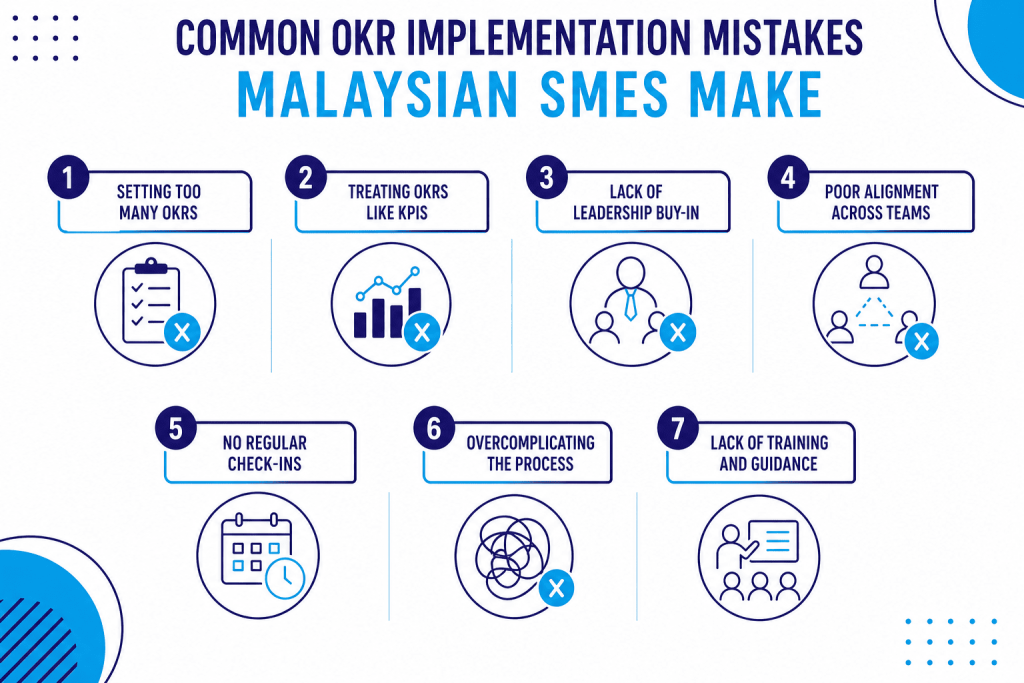
Common OKR Implementation Mistakes Malaysian SMEs Make
Setting Too Many OKRs
Many SMEs make the mistake of trying to achieve too much within a single OKR cycle. This often leads to scattered focus and reduced execution quality across teams.
- Trying to achieve too many goals at once
- Creating excessive objectives that dilute focus
- Overwhelming teams with too many priorities
Fix:
Focus on 3 to 5 key objectives per cycle and prioritize what truly drives impact. A streamlined approach ensures your OKR implementation remains clear and effective.
Treating OKRs Like KPIs
A common misunderstanding is treating OKRs as traditional performance metrics rather than a strategic goal-setting framework.
- Using OKRs only to track routine performance
- Confusing OKRs with KPIs
- Avoiding ambitious or stretch targets
Fix:
Use OKRs to drive growth and innovation, not just to measure performance. Set ambitious goals that challenge teams while keeping KPIs separate for tracking.
Lack of Leadership Buy-In
Without strong leadership involvement, OKR implementation often lacks direction and fails to gain traction across the organisation.
- Leadership not actively participating
- Unclear strategic direction
- Teams treating OKRs as a low priority
Fix:
Leaders must actively champion OKR implementation by setting clear priorities, communicating vision, and participating in regular reviews.
Poor Alignment Across Teams
When teams are not aligned, OKRs can create confusion instead of clarity, leading to inefficiencies and conflicting priorities.
- Departments working in silos
- Misaligned or conflicting objectives
- Lack of visibility across teams
Fix:
Ensure OKRs are aligned from the company level down to teams and individuals. Clear alignment improves collaboration and overall performance.
No Regular Check-Ins
OKRs are not a set-and-forget system. Without consistent tracking, teams lose focus and accountability.
- No regular progress reviews
- Lack of accountability during the cycle
- Missed opportunities to adjust priorities
Fix:
Schedule weekly or bi-weekly check-ins to review progress, address challenges, and keep your OKR implementation on track.
Overcomplicating the Process
Some SMEs introduce unnecessary complexity into OKR implementation, making it difficult for teams to adopt and sustain.
- Using overly complex frameworks
- Introducing too many tools or layers
- Making OKRs difficult to understand
Fix:
Keep your OKR implementation simple, especially at the start. A clear and practical structure improves adoption and consistency.
Lack of Training and Guidance
Without proper training, teams may struggle to understand how to set and use OKRs effectively.
- Unclear understanding of OKR structure
- Poorly written objectives and key results
- Low adoption across teams
Fix:
Invest in proper OKR training in Malaysia or work with an experienced OKR coach to ensure your team has the knowledge and support needed for success.
Warning Signs Your OKR Implementation Needs Improvement
Even if your organisation has already started using OKRs, certain warning signs may indicate that your OKR implementation is not delivering its full value. Identifying these early allows you to make adjustments before they impact overall performance.
Team Engagement Is Low
If employees see OKRs as extra administrative work rather than a useful framework, engagement will naturally drop. Over time, this leads to low participation and weak adoption across teams.
Objectives Feel Disconnected
Teams should clearly understand how their objectives contribute to broader company goals. When this connection is missing, employees may feel their work lacks purpose or strategic direction.
Progress Is Hard to Measure
Well-defined key results should make progress easy to track. If metrics are unclear, inconsistent, or difficult to quantify, it becomes challenging to assess performance and make informed decisions.
Reviews Feel Unproductive
OKR check-ins should be focused, action-driven discussions that address progress, blockers, and next steps. If meetings feel like routine status updates with little outcome, your review process may need improvement.
Quick Comparison: Effective vs Poor OKR Implementation
| Aspect | Effective Implementation | Poor Implementation |
|---|---|---|
| Focus | 3 to 5 clear objectives | Too many priorities |
| Alignment | Company-wide clarity | Siloed goals |
| Leadership | Actively involved | Passive or absent |
| Tracking | Regular check-ins | No follow-up |
| Complexity | Simple and practical | Overly complicated |
| Support | Training and coaching | No guidance |

How Malaysian SMEs Can Improve OKR Implementation
Improving OKR implementation does not require a complete reset. In most cases, small changes can significantly improve outcomes.
Start With Clear Priorities
Define what matters most for the business over the next quarter.
Simplify Your Framework
Remove unnecessary complexity and focus on usability.
Build Accountability
Assign ownership and maintain consistent review rhythms.
Invest in Expertise
Working with an experienced OKR company in Malaysia can reduce implementation mistakes and accelerate adoption.
Why Work With an OKR Coach?
For SMEs new to OKRs, external guidance often shortens the learning curve and improves success rates.
An experienced OKR coach in Malaysia can help your business:
- Design an effective implementation roadmap
- Train leaders and teams
- Improve OKR quality and alignment
- Build sustainable review processes
- Avoid common implementation pitfalls
Professional support often turns OKRs from a theoretical framework into a practical business system.
A Simple OKR Implementation Framework for SMEs
For SMEs new to OKRs, starting simple is often the best approach. A structured framework can make OKR implementation easier, more practical, and sustainable over time.
Step-by-step approach:
Define Business Priorities
Start by identifying what matters most for the upcoming quarter. This ensures your OKRs are aligned with overall business direction.
Define Company Objectives
Set 3 to 5 high-level goals that reflect your key priorities and strategic focus.
Set Outcome-Based Key Results
Ensure each objective has clear, measurable results that focus on outcomes rather than activities.
Assign Ownership
Each objective and key result should have a clear owner responsible for driving progress.
Align Teams and Departments
Translate company OKRs into team-level objectives to ensure alignment across the organisation.
Establish a Review Rhythm
Schedule weekly or bi-weekly check-ins to track progress, address challenges, and maintain accountability.
Evaluate and Improve
At the end of each cycle, review performance, identify lessons learned, and refine your approach for the next cycle.
Ready to Improve Your OKR Implementation?
Whether you are launching OKRs for the first time or refining an existing framework, expert guidance can improve adoption and results.
Get tailored support, practical training, and implementation strategies designed for Malaysian businesses.
Final Thoughts
Many Malaysian SMEs do not struggle because OKRs are ineffective. They struggle because implementation is often rushed, misunderstood, or unsupported.
Avoiding these common OKR implementation mistakes can help your organisation build stronger alignment, clearer priorities, and better execution.
With the right structure, leadership commitment, and training, OKRs can become a powerful growth framework for your business.
Frequently Asked Questions (FAQs)
Is OKR implementation complicated for a small team?
It can feel complex at first, but OKRs are designed to be simple. Starting with a small number of objectives and keeping the structure straightforward makes it much easier for small teams to adopt.
Will OKRs increase my team’s workload?
Not if implemented correctly. OKRs help teams focus on what matters most, which often reduces unnecessary work rather than adding more tasks.
What happens if we fail to achieve our OKRs?
Failing to fully achieve OKRs is normal, especially since they are meant to be ambitious. The goal is progress and learning, not perfection.
How do I know if my OKR implementation is working?
You will start to see clearer priorities, better alignment across teams, improved accountability, and more consistent progress tracking within a few cycles.
Should OKRs be tied to employee performance or bonuses?
It is generally not recommended. Tying OKRs directly to bonuses can discourage teams from setting ambitious goals and reduce the effectiveness of the framework.
Can we use OKRs together with KPIs?
Yes, many companies use both. KPIs track ongoing performance, while OKRs focus on driving strategic growth and change.
When is the right time to start OKR implementation?
The best time is when your business is growing, facing alignment issues, or struggling with prioritisation. Starting early helps build a strong foundation for scaling.