

Many organizations adopt Objectives and Key Results (OKRs) with high expectations. The framework has been used by successful companies worldwide to improve focus, alignment, and execution. However, despite its simplicity, many OKR initiatives fail to deliver the expected results.
The problem is rarely the OKR framework itself.
In most cases, organizations struggle because of how OKRs are introduced, managed, and integrated into their existing ways of working. Industry experts consistently point to implementation issues, leadership involvement, alignment challenges, and poor execution habits as the primary reasons why OKR rollouts fail.
If your organization is considering OKR implementation or has already started the journey, understanding these common pitfalls can significantly improve your chances of success.
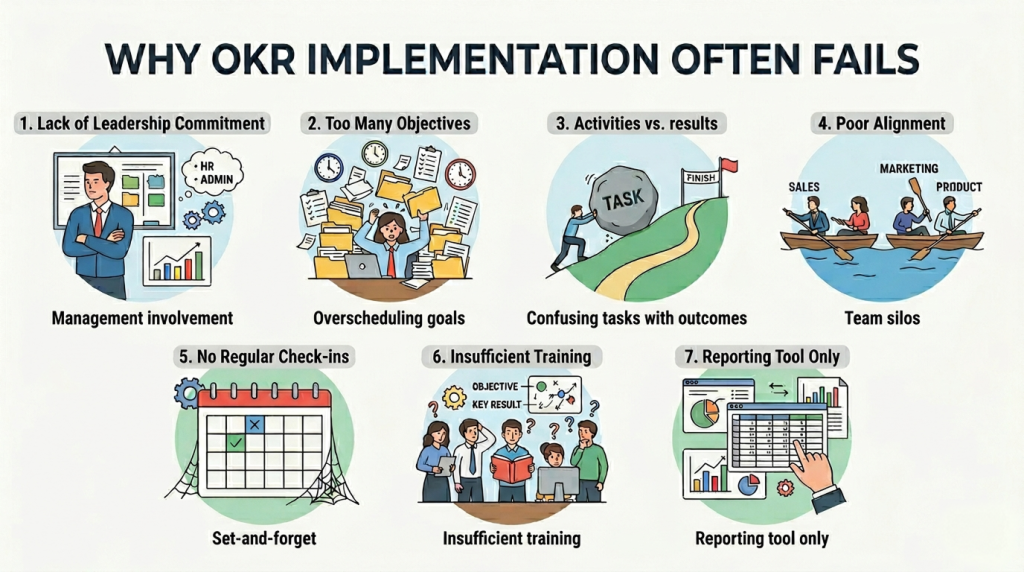
Why OKR Implementation Often Fails
Many companies assume that OKRs are simply another goal-setting tool.
In reality, OKRs require changes in how teams prioritize work, align objectives, review progress, and make decisions. Organizations that treat OKRs as a one-time exercise often struggle to sustain momentum after the initial rollout.
Below are the most common reasons OKR implementations fail and what successful organizations do differently.
1. Lack of Leadership Commitment
One of the biggest reasons OKR implementation fails is the lack of visible leadership involvement.
When OKRs are delegated entirely to HR or middle management, employees often view them as another administrative initiative rather than a strategic management system. Successful implementations require leaders to actively set, review, and communicate company-level OKRs.
How to Avoid It
- Ensure leadership defines and owns company-level OKRs.
- Review OKR progress regularly at leadership meetings.
- Communicate organizational priorities consistently.
- Lead by example by using OKRs at the executive level.
When leaders actively participate, teams are far more likely to embrace the framework.
2. Setting Too Many Objectives
A common mistake is trying to include every business activity within OKRs.
Teams often create lengthy lists of objectives and key results, making it difficult to identify what truly matters. As a result, employees become overwhelmed and lose focus.
How to Avoid It
Focus only on the most important priorities.
Most OKR practitioners recommend limiting:
- 3 to 5 company objectives
- 3 to 5 key results per objective
Remember, OKRs are designed to highlight strategic priorities, not document every task.
3. Confusing Activities with Results
Many organizations write key results as tasks instead of measurable outcomes.
For example:
- Launch a new marketing campaign
- Conduct customer surveys
These are activities, not results.
A stronger key result would be:
- Increase qualified leads from 500 to 800 per month
- Improve customer satisfaction score from 75% to 85%
Successful OKRs measure business outcomes, not the completion of tasks.
How to Avoid It
Ask:
“What measurable change will happen if this activity is successful?”
The answer should become your key result.
4. Poor Alignment Across Teams
Another common challenge is siloed OKRs.
Departments create goals independently without understanding how they contribute to company objectives. This often results in teams working hard but moving in different directions.
How to Avoid It
Before finalizing departmental OKRs:
- Review company-level objectives.
- Conduct cross-functional alignment discussions.
- Ensure team OKRs support organizational priorities.
Strong alignment creates clarity and reduces conflicting priorities.
5. No Regular Check-In Process
Many companies set OKRs at the beginning of the quarter and only revisit them at the end.
This “set-and-forget” approach is one of the most common causes of OKR failure. Without regular reviews, teams lose visibility, accountability, and momentum.
How to Avoid It
Establish a consistent operating rhythm:
- Weekly OKR check-ins
- Monthly progress reviews
- Quarterly reflection and planning sessions
Regular discussions help teams identify obstacles early and adjust priorities when needed.
6. Insufficient OKR Training
Many employees encounter OKRs for the first time during implementation.
Without proper training, teams often:
- Write weak objectives
- Create KPI-style key results
- Focus on activities instead of outcomes
- Struggle to align their work with company goals
Several experienced practitioners highlight that OKR adoption requires learning, practice, and coaching rather than a single workshop.
How to Avoid It
Provide structured training for:
- Leadership teams
- Department managers
- Team members
- Internal OKR champions
Continuous coaching can significantly improve adoption and long-term success.
7. Treating OKRs as a Reporting Tool Instead of a Management System
Some organizations use OKRs purely to track performance.
However, successful companies use OKRs to guide decision-making, prioritization, and execution. When OKRs become just another reporting exercise, employees stop seeing their value.
How to Avoid It
Use OKRs to:
- Drive strategic conversations
- Prioritize initiatives
- Allocate resources
- Make better business decisions
OKRs should influence how the organization operates, not simply how it reports results.
What Successful OKR Implementations Do Differently
Organizations that succeed with OKRs often share several common practices:
Leadership Drives the Process
Executives actively participate in defining and reviewing OKRs.
Teams Focus on Outcomes
Key results measure meaningful business impact rather than completed activities.
Alignment Is Built Into the Process
Company, department, and individual objectives support a common direction.
Regular Reviews Create Accountability
Progress is reviewed consistently throughout the quarter rather than only at the end.
Internal Capability Is Developed
Organizations invest in training internal OKR champions to sustain the initiative long term.
How Growth Mindset Global Helps Companies Implement OKRs Successfully
At Growth Mindset Global, we understand that successful OKR implementation requires more than simply writing objectives and key results.
Our approach focuses on helping organizations:
- Align strategy with execution
- Build leadership commitment
- Develop internal OKR champions
- Improve employee engagement
- Establish sustainable OKR practices
Using our proven crawl-walk-run methodology, we guide organizations through every stage of their OKR journey, ensuring teams adopt OKRs effectively and achieve measurable business results.
Whether you are implementing OKRs for the first time or looking to improve an existing program, our team can help you build a stronger foundation for long-term success.
Ready to Improve Your OKR Implementation?
If your organization is exploring OKRs or facing challenges with adoption, we would be happy to help.
Speak with our OKR coaches to discuss your goals, challenges, and implementation plans.
Contact us today to learn how effective OKR implementation can improve focus, alignment, and business performance across your organization.
Frequently Asked Questions (FAQs)
Why do OKR implementations fail?
OKR implementations usually fail because of poor leadership involvement, too many objectives, weak alignment across teams, lack of regular check-ins, and insufficient training. The framework itself is rarely the problem; execution and adoption are.
How long does OKR implementation take?
Most organizations need one to three OKR cycles to establish a stable implementation rhythm. The timeline depends on company size, leadership readiness, and how quickly teams adopt the process.
What is the biggest mistake companies make when implementing OKRs?
The most common mistake is treating OKRs as a one-time goal-setting exercise instead of an ongoing management system with regular reviews, alignment discussions, and coaching.
Do SMEs need an OKR coach?
SMEs can implement OKRs independently, but an experienced OKR coach often shortens the learning curve, prevents common mistakes, and helps build sustainable internal practices.
How often should OKRs be reviewed?
A practical cadence is weekly team check-ins, monthly progress reviews, and quarterly reflection and planning sessions. Regular reviews keep priorities visible and help teams adjust quickly.
What is the difference between OKR implementation and OKR training?
OKR training teaches the framework, writing quality objectives and key results, and review practices. OKR implementation adds hands-on rollout support, alignment sessions, coaching, and ongoing guidance during actual OKR cycles.
Can OKRs replace KPIs?
Not necessarily. OKRs and KPIs serve different purposes. KPIs monitor ongoing operational health, while OKRs drive strategic change, focus, and measurable progress toward new priorities. Many organizations use both together.
How do I choose an OKR company in Malaysia?
When choosing an OKR company in Malaysia, look for practical implementation experience, leadership coaching expertise, and a structured approach to OKR adoption. At Growth Mindset Global, we combine hands-on implementation support, CEO coaching, and internal OKR coach development to help organizations build sustainable OKR practices and achieve measurable business results.